
Pensions

Inability to work: what the IV (disability insurance) and the pension fund pay, and where gaps remain

Updated on · first published on · 5 min read

If you are unable to work for a longer period because of illness or an accident, you suffer a loss of income. Several types of insurance cover this, one after the other and depending on the cause. Where their benefits end, a gap arises that income protection insurance can close.
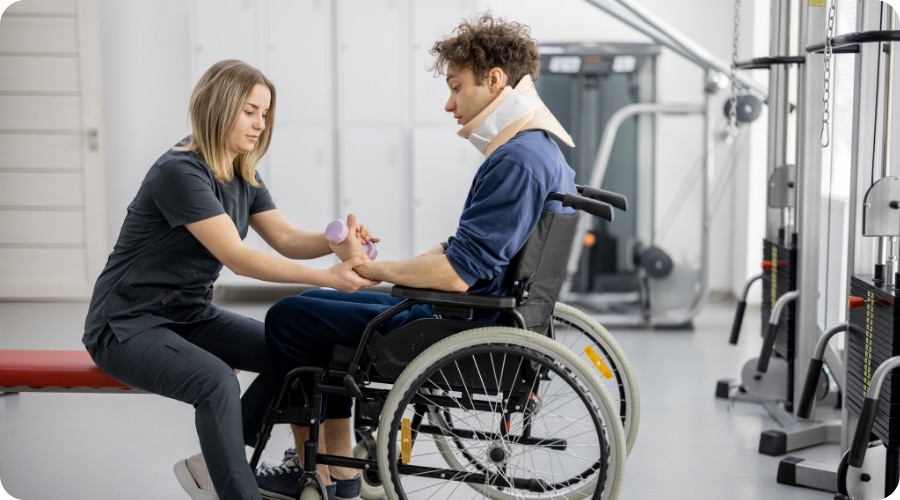
A man wearing a neck brace sits in a wheelchair during physiotherapy

The essentials at a glance

  • First, your employer continues to pay your salary, in the case of illness often through daily allowance insurance.
  • An IV (disability insurance) pension is available at the earliest after one year of incapacity for work and from a degree of disability of 40%.
  • After an accident, accident insurance pays employees a daily allowance and, in the case of full disability, a pension of 80% of the insured salary, coordinated with the IV. In the case of illness, this benefit does not apply.
  • Private income protection insurance pays an agreed annuity if you can no longer work at all or only partially.

Who pays when?

Financial protection is provided in several phases:

  • Illness, the first weeks: your employer continues to pay your salary for a limited time if the employment relationship has lasted more than three months or was entered into for more than three months: for three weeks in the first year of service, and for an appropriately longer period after that. Many employers have instead taken out daily sickness allowance insurance, which is voluntary. Under the KVG, it pays benefits for at least 720 days within a period of 900 days; for contracts under the VVG, the duration is set out in the contract.
  • Accident: from the third day after the accident, employees receive a daily allowance of 80% of the insured salary from accident insurance. Salaries up to CHF 148'200 a year are insured.
  • After one year, the IV: you are entitled to an IV pension if reintegration is not possible, you were on average at least 40% unable to work over one year and are then at least 40% disabled. From a degree of disability of 70%, you receive a full pension; below that, a partial pension. The pension starts at the earliest six months after you register. You should therefore register with the IV office at an early stage.
  • Plus the pension fund and, after an accident, accident insurance: if you were insured in a pension fund when your incapacity for work began and are at least 40% disabled, you also receive a disability pension from it, graded as with the IV. After an accident, accident insurance pays a disability pension: 80% of the insured salary in the case of full disability, coordinated with the IV pension.

Where the gap arises

IV and the pension fund do not usually replace your entire previous salary. How big the gap is depends on your salary, your pension fund and your family situation, and on whether illness or an accident is the cause. There is no generally applicable percentage, so you should calculate the gap on the basis of your own documents.

To do this, you need your pension fund certificate and the regulations of your pension fund, as well as details of your employer’s daily allowance insurance. These show which benefits you would receive if the worst happened.

Particularly affected: the self-employed

The self-employed have no employer to continue paying their salary. Daily allowance insurance, accident insurance under the UVG and a pension fund are voluntary for them. Without a solution of their own, they therefore mainly depend on the IV in the event of illness.

What private income protection insurance provides

Income protection insurance pays an agreed monthly annuity if you can no longer work at all, or only partially, because of illness or an accident. It is offered as a stand-alone policy or as part of a pension solution in pillar 3a or 3b. When comparing, pay attention to the following points:

  • Waiting period: this determines when the annuity starts to be paid out. A longer waiting period lowers the premium and makes sense if a daily allowance covers the initial period.
  • Amount: the annuity should cover the gap that remains after the benefits from the IV and your pension fund.
  • Duration: the annuity is usually paid until the AHV reference age of 65.
  • Definition: what matters is the degree of loss of earning capacity from which the insurance pays benefits and whether it also pays in the event of a partial loss of earning capacity.
  • Health questions: the insurer may ask health questions and impose exclusions. Answer them completely and truthfully, otherwise you may lose your insurance cover.

Think of your family

If you have children or earn most of the family income, a loss of earnings affects the whole family. You should therefore also check how your family is protected in the event of death, for example with term life insurance. If you are cohabiting without being married, there is no AHV survivor’s pension: you have to arrange the beneficiary designation in your pension fund and pillar 3a yourselves.

Frequently asked questions

What is the difference between occupational disability and loss of earning capacity?

In Germany, people usually insure against occupational disability, meaning the loss of the ability to practise their own occupation. In Switzerland, the IV and pension funds look at loss of earning capacity: what matters is whether you can still earn any income at all, including in a different occupation. Private insurers may use their own definitions.

When do I get an IV pension?

You are entitled to a pension if reintegration is not possible, you were on average at least 40% unable to work over one year and your degree of disability is then at least 40%. The pension starts at the earliest six months after you register. You should therefore register with the IV office at an early stage.

Do I need income protection insurance if I have a pension fund?

That depends on your pension gap. Use your pension fund certificate to calculate which benefits the IV and your pension fund would provide, and compare these with the amount you need to live on.

Sources and last update

  1. Art. 28, 28b and 29 IVG: entitlement, linear pension system since 2022, start at the earliest six months after registration (fedlex.admin.ch, as at 1 January 2026, checked on 14 October 2026).
  2. Art. 324a OR: continued payment of salary in the case of illness (the Bern, Zurich and Basel scales are case law); Art. 67 and 72 KVG: voluntary daily allowance insurance, at least 720 days within 900 days (fedlex.admin.ch, as at 1 January 2026, checked on 14 October 2026).
  3. Art. 16, 17, 18 and 20 UVG, Art. 22 UVV: daily allowance from the third day, 80%, disability pension, maximum insured earnings CHF 148'200 (fedlex.admin.ch, as at 1 January 2026, checked on 14 October 2026).
  4. Art. 23 and 24a BVG: disability benefits from the pension fund from 40%, graded as with the IV (fedlex.admin.ch, as at 1 January 2025, checked on 14 October 2026).
  5. Art. 4 UVG, Art. 4 BVG, Art. 67 KVG: voluntary insurance for the self-employed (fedlex.admin.ch).
  6. ch.ch, ‘Cohabitation’: no AHV survivor’s pension, beneficiaries in pension fund and pillar 3a according to the regulations.

As at 14 October 2026. This article gives a general overview and does not replace individual advice. The laws and the terms and conditions of your insurance take precedence. Figures and deadlines are as at the date stated and may change.

Read more: Pensions and life insuranceWhat is pillar 3b?Insurance glossary

How big is your gap?

Using your pension fund certificate, we calculate what you would be missing if the worst happened and compare suitable solutions. Our advice is free and comes with no obligation.